How to Evaluate Translation Quality When You Don’t Speak the Language
Here is the honest answer first: you cannot certify that a translation is natural and accurate in a language you cannot read. You can still check whether it is complete, whether critical facts survived, where two systems disagree, and which passages need a qualified human.
That distinction matters. A non-speaker’s review should reduce risk and prepare a better handoff, not create false confidence. The workflow below is useful for reading foreign material, preparing an internal draft, or directing professional review to the passages that need it most.
First decide what the translation will be used for
| Use | Reasonable finish line |
|---|---|
| Personal understanding | Machine translation plus a basic completeness check. |
| Internal research | Basic check plus human review of claims you will rely on. |
| Customer support draft | Native review for meaning, tone and local expectations. |
| Public marketing or publication | Professional bilingual editing of the full text. |
| Medical, legal, safety or contractual use | An appropriately qualified human translator; do not approve it yourself. |
The same machine output can be adequate for understanding a news article and completely inappropriate for a consent form. Quality is not just a score; it is fitness for a specific consequence.
What you can verify without speaking the target language
- Completeness: headings, paragraphs, lists and sections are present.
- Invariant details: names, numbers, dates, units, product codes, URLs and citations survived.
- Formatting: title hierarchy, line breaks and list structure still make sense.
- Consistency signals: repeated names and terms appear in the same written form.
- Suspicious disagreement: independent translations express materially different facts.
What you cannot reliably verify
- whether a sentence sounds natural rather than translated;
- whether politeness, register, humour or emotional tone is appropriate;
- whether a technical term is the one professionals actually use;
- whether an ambiguity was resolved correctly;
- whether a fluent sentence subtly reverses the source meaning.
Typography is not a substitute for comprehension. The fact that the target contains plausible-looking words, varied punctuation and tidy paragraphs tells you almost nothing about accuracy.
Step 1 — Run a completeness audit
Put source and target side by side. Match headings and list lengths. Search for numbers, names and identifiers. Sample paragraphs throughout the document and make sure each has a target counterpart. Our separate missing-sentence checklist gives the full method.
Step 2 — Make an “invariants” table
Copy facts that should remain equivalent into a small sheet before you become distracted by the prose.
| Source | Expected behaviour | Target check |
|---|---|---|
| €4,250 | Same amount; punctuation may localise | □ |
| 18 March 2027 | Same date; order may localise | □ |
| not later than | Deadline restriction must remain | Human check |
| Seam Swift | Product name unchanged | □ |
Numbers are easy to compare, but their surrounding labels matter. Finding “30” in both texts does not prove that 30 days did not become 30 hours. Mark the unit and context too.
Step 3 — Check name and term consistency
Pick every person, organisation, product and recurring technical term. Search the target for the written form used the first time. Multiple target spellings may be legitimate because of grammar, but they are a reason to ask a speaker rather than assume.
For important projects, create a small translation glossary before the main run. A reviewer can approve those terms once instead of correcting the same choice throughout 80 pages.
Step 4 — Compare two independent translations carefully
Translate a handful of high-risk passages with a second, genuinely independent tool or human. Compare the meaning after translating both results into a language you understand. Agreement is reassuring but not proof; systems may share the same common error. Disagreement is useful because it tells you exactly where to spend human attention.
Choose the sample before seeing the outputs
Include the conclusion, recommendations, numbers, negations, ambiguous pronouns, idioms and any sentence you plan to quote. Do not sample only the simple opening paragraphs, where almost every system performs well.
Why back-translation is only a smoke alarm
Back-translation means translating the target back into the source language. It can reveal a missing fact or startling change. It cannot prove quality: the second pass may repair an error, introduce a new one or turn several different target phrases into the same familiar source phrase.
Use it to generate questions. If “may” returns as “must”, or a negative disappears, flag that sentence for a bilingual reviewer. Do not accept a whole document because the back-translation looks similar.
Step 5 — Give a reviewer a precise brief
A vague request to “check whether this is good” wastes expert time. Send the source, target, intended audience and purpose, plus your glossary and issue list. Ask for one of these clearly defined levels:
- Spot check: review selected risky passages and report the error pattern.
- Accuracy review: compare every target passage with the source and correct meaning errors.
- Publication edit: accuracy review plus natural style, tone and local conventions.
If the spot check finds a serious error, expand the scope. One sample cannot statistically certify the unreviewed pages.
Step 6 — Turn corrections into repeatable rules
When a reviewer fixes a name or recurring term, update the glossary and search the entire target. When they find a pattern — for example, polite requests becoming commands — inspect other passages with the same source construction. Correcting only the marked sentence leaves the underlying issue scattered through the document.
A practical stoplight system
| Signal | Action |
|---|---|
| Green: personal comprehension, structure complete, facts intact | Use it as a reading aid while retaining the source. |
| Amber: important internal decision, independent outputs disagree | Review disputed and decision-critical passages with a speaker. |
| Red: publication, safety, rights, money, health or legal effect | Commission a qualified full review regardless of how good the output looks. |
Where Seam fits
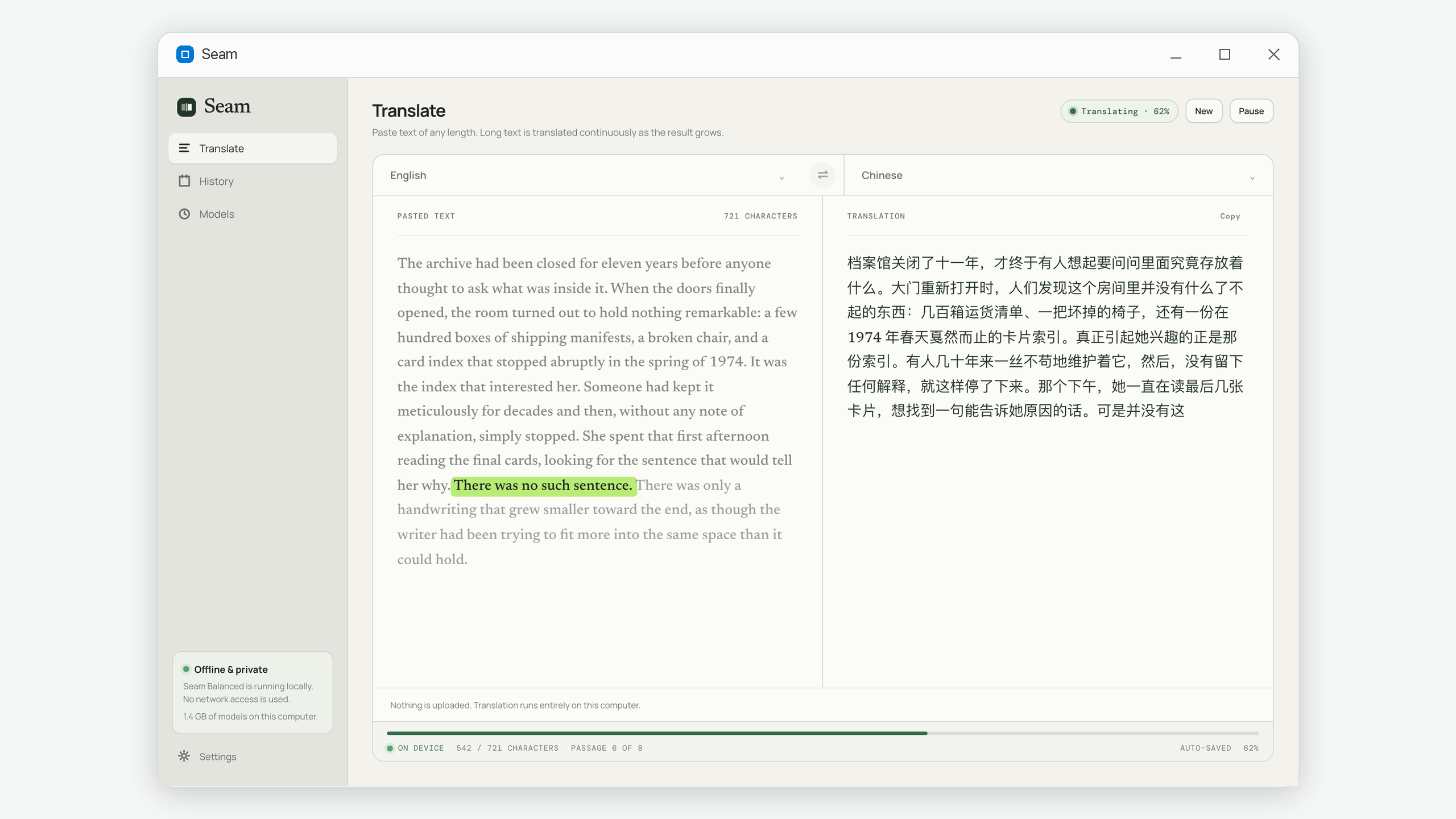
Seam is useful for the first complete draft of a long or private document. It runs a translation model on your computer, keeps source and target together, and resumes interrupted work. It does not claim to certify a translation. For anything consequential, export the result into the reviewer workflow above.
Common questions
Can I ask another AI whether the translation is accurate?
It can flag suspicious passages, but it is still another unaccountable machine judgment. Treat its comments as leads for a bilingual reviewer, not certification.
If two translators agree, is the translation correct?
Agreement raises confidence but does not prove correctness. Both can choose the same common mistranslation or miss the same ambiguity.
Is back-translation useful at all?
Yes, for finding gross changes in sampled passages. It is poor as a final quality score and should not replace source-to-target review.
Can a native target-language speaker review without the source language?
They can improve fluency and identify awkward wording, but cannot reliably verify that the target preserves the source. Accuracy review needs someone who can compare both.
Seam produces a complete local draft without uploading the source, ready for the right level of human review. Get it on the Microsoft Store.